QuietWire engagements start narrow and expand based on what holds. We work with one high-value workflow first, prove the architecture in your environment, then scale through training and phased rollout.




The model
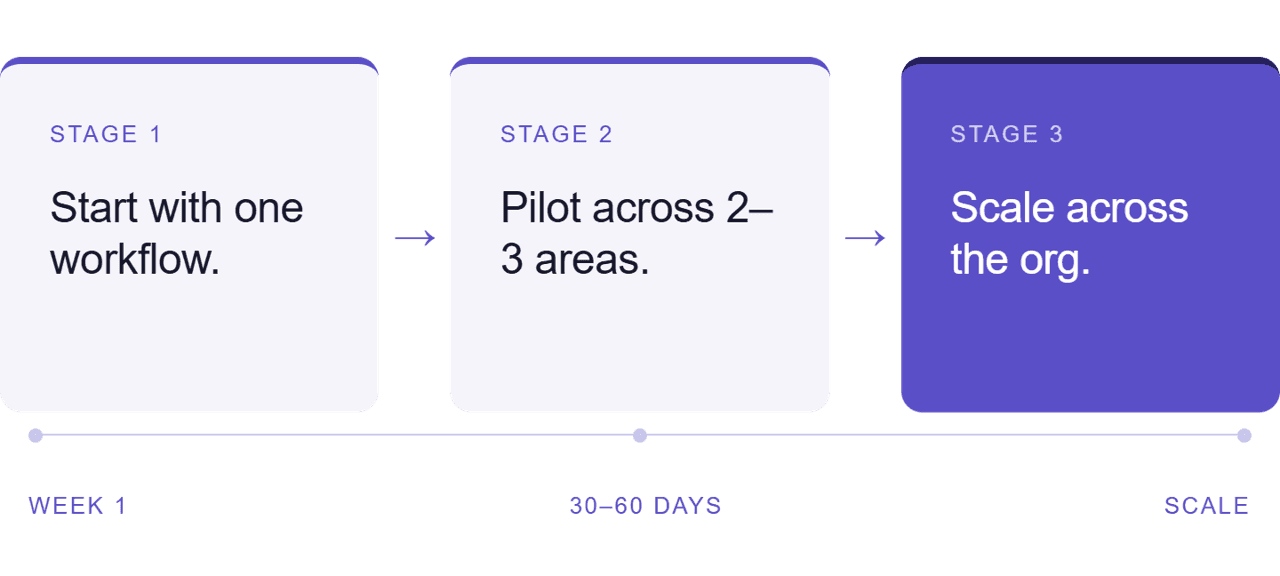
Three Stages. From Workflow to Adoption.
Every QuietWire engagement follows the same arc. The architecture is the same; the speed and scope adapt to your operating environment, your hardware, and your timeline.

Week 1
Stage 1
Choose a workflow that requires explainable, evidence-based, resilient decisions. The kind of work where reasoning matters as much as output, and where the institution needs to stand behind what was decided.
Define the essentials: identity, evidence, rules, approvals, recordkeeping. Deploy QuietWire on infrastructure you already own. Test against real work, not synthetic scenarios.
By the end of Week 1, you have a working node, a captured record of one real workflow, and the operational pattern for everything that comes next.
30–60 days
Stage 2
Expand from one workflow to a small number of areas where continuity and accountability matter most. The architecture stays the same; the scope widens to test the pattern across different kinds of institutional work.
Common pilot areas: policy and regulatory files, program or case management, procurement and vendor risk.
By the end of 30–60 days, you have evidence of how QuietWire holds across multiple operational contexts in your specific environment, and a clear read on what's working, what needs tuning, and where the architecture creates the most institutional value.
Scale
Stage 3
Equip leaders, frontline staff, and technical teams to operate QuietWire at institutional scale. Build confidence through exercises, playbooks, and real-stakes practice. Roll out in phases with clear value metrics at each step.
Standardize where standardization helps. Keep local control where local control matters. The institution chooses what gets unified and what stays sovereign to the team or office that owns it.
By the end of scale, QuietWire is institutional infrastructure. Owned by you, operated by your team, woven into how decisions get made and recorded across the organization.
Engagement Principles
How We Partner
QuietWire is decision integrity infrastructure. The engagement model reflects what that means in practice. Pilots are scoped to real conditions, the institution stays in control of its own deployment, and the partnership adapts to the operating environment rather than imposing a fixed playbook.
We meet your environment as it is.
Every decision is captured with its full context and cryptographically signed so it can't be altered after the fact.
The institution stays in control.
What your organization knows persists across teams, transitions, and time, so decisions build on each other instead of starting from scratch.
Pilots are scoped to value, not duration.
When the record is challenged, export evidence-grade proof. Everything runs on infrastructure you own, including offline. Your institutional memory is always yours.
We work with you on the long arc.
QuietWire is institutional infrastructure. Adoption isn't a deployment event. It's a structural shift in how the organization preserves its own reasoning. The engagement supports that shift across stages, conditions, and the changes the institution will go through during and after rollout.
QuietWire is in use today across diverse environments — in the US, Canada, and the Middle East. Pilots available now.

FAQ
Questions: How QuietWire Runs
Practical answers on how the architecture works.
How does QuietWire know what counts as a decision?
Decision context is captured automatically as your team works in the AI companion — research, drafting, coordination, decision-making. The system records what makes each decision unique and reviewable: what was asked, what was considered, what was chosen, who was involved, what role AI played, along with the wider context. You don't tag decisions manually. Context is captured as your team works.
What does "cryptographically signed" actually mean?
QuietWire runs on infrastructure you own and control — your servers, your environment. No data is transmitted externally during normal operation. You don't depend on anyone else's cloud to access your own institutional memory.
Is the record human-readable, or only machine-queryable?
Both. The underlying record is structured so the system can query it precisely. But your team interacts with it in natural language through the AI companion, and exports are produced in standard human-readable formats. You don't need technical skills to use it.
Can we connect it to our existing systems?
Yes. QuietWire sits alongside your current tools and workflows, not replacing them. It captures decision context from the work your team is already doing.
What does on-premise really mean?
QuietWire runs on infrastructure you own and control — your servers, your environment. No data is transmitted externally during normal operation. You don't depend on anyone else's cloud to access your own institutional memory.
Is our data safe?
Your data never leaves your infrastructure. Only a direct request to your organization could access it. QuietWire has no access to your data, records, or memory.
What happens if we lose connectivity?
QuietWire is offline-first by design. The system continues operating normally without internet. When connectivity returns, records are automatically reconciled into a single verifiable history.
What happens to the record if we change infrastructure?
The record is yours, in documented exportable formats. If you migrate to new servers, change cloud providers, or restructure your environment, the record moves with you. Data portability is a core design principle, not a contractual claim.
What does the AI companion run on?
The companion is modular. You can run it on whatever model your organization prefers — local open-source models, hosted models, your own. QuietWire doesn't lock you into a specific model or vendor. The architecture is built so the model layer can change without affecting the record itself.
How do multiple nodes stay consistent across sites?
Each node operates independently and signs its own records locally. When nodes connect — continuously or after offline periods — they reconcile automatically into a single verifiable history. No central server holds the master copy. The mesh is consistent because every node carries its own signed record, and reconciliation merges them without losing context.

Contact Us & Get Started
Operational and in the field. Let's talk.
QuietWire is live and deployed. Pilots available now.